

OSG logo
OSG logo
Contact
PAThPelican PlatformIRIS-HEP

Presentations

Analyzing and Optimizing Machine Timeout Duration Using AI (Remote Presentation)
Khyathi Vagolu at HTC26
HTC26
AI
HTCondor
Research Computing
Workflow
High Throughput Computing

Khyathi Vagolu presents a machine learning approach to improving HTCondor job lease timeouts by replacing a fixed timeout with a dynamically optimized value. The talk explores how Bayesian optimization can reduce unnecessary job failures and wasted computing resources while adapting to changing conditions in distributed computing environments.
June 12, 2026
Climate Policy Modeling with HTCondor
Ken Judd at HTC26
HTC26
Data
HTCondor
Research Computing
Workflow
High Throughput Computing
Ken Judd explores how HTCondor enables large-scale climate and economic policy modeling by making complex simulations practical to run. The talk highlights how high throughput computing supports dynamic programming, climate risk analysis, and economic models used to evaluate policies such as carbon pricing.
June 12, 2026
HTCondor operational improvement efforts @ BNL
Tom Smith at HTC26
HTC26
HTCondor
Research Computing
Workflow
Infrastructure
Tom Smith shares practical improvements Brookhaven National Laboratory has made to streamline HTCondor operations, from simplifying system configuration and automation to improving monitoring and resource management. The talk highlights tools and techniques that increase efficiency, reduce operational overhead, and help optimize large-scale computing infrastructure.
June 12, 2026
INK (Interactive aNalysis worKbench) : Progress and AI Exploration (Remote Presentation)
Jingyan Shi at HTC26
HTC26
AI
Data
HTCondor
Research Computing
Workflow
Jingyan Shi presents the latest developments in INK, an interactive analysis platform that simplifies access to computing resources for high energy physics researchers. The talk highlights new workflow tools, real-time job monitoring, one-click deployment, and early efforts to integrate AI agents with HTCondor to streamline scientific computing.
June 12, 2026
MCP for HTCondor Admins
Ilija Vukotic at HTC26
HTC26
AI
HTCondor
Research Computing
Workflow
Ilija Vukotic presents how AI agents and the Model Context Protocol (MCP) can help HTCondor administrators monitor systems, troubleshoot issues, and automate routine operations. The talk explores a secure, human-in-the-loop approach to integrating AI assistants into large-scale research computing infrastructure.
June 12, 2026
YOL-No: Guiding Agent Usage on the Access point
Ian Ross at HTC26
HTC26
AI
HTCondor
Research Computing
Ian Ross discusses the challenges AI coding agents introduce to shared HTCondor access points and explores practical strategies for using them safely. The talk examines approaches such as resource limits, guided agent behavior, trusted AI tools, and user education to help balance innovation with responsible research computing.
June 12, 2026
Authorizing Remote Placement with the PlacementD
Matyas Selmeci at HTC26
HTC26
HTCondor
Workflow
Matyas Selmeci presents PlacementD, a new authorization system that enables users to securely submit and manage HTCondor jobs remotely without requiring shell access to an access point. The talk covers placement tokens, remote job management, project-based authorization, and improvements to secure research computing workflows.
June 11, 2026
Auto-regulating input files that save time when jobs fail
Benjamin FitzGerald at HTC26
HTC26
HTCondor
High Throughput Computing
Workflow
Benjamin FitzGerald demonstrates an HTCondor and DAGMan workflow that automatically manages dynamic input files and item-level retries for large-scale precipitation analysis. By automating file handling and recovery from missing data, the approach reduces manual intervention, improves workflow reliability, and accelerates hydrologic modeling for flood risk research.
June 11, 2026
CHTC Fellows Lightning Talks
Daniella Wright & Snikitha Siddavatam at HTC26
HTC26
HTCondor
Fellows
CHTC Summer Fellows Daniella Wright and Snikitha Siddavatam present their projects on enhancing CHTC documentation and measuring throughput using a standardized workflow.
June 11, 2026
Files Common Across Jobs (Part II)
Todd Miller at HTC26
HTC26
HTCondor
Data
Workflow
Research Computing
Todd Miller introduces new HTCondor capabilities that reduce redundant file transfers by reusing common files and container images across related jobs. The talk explains how these improvements lower bandwidth usage, improve efficiency, and accelerate workflows for data-intensive computing.
June 11, 2026
From Per-Job Data to an Aggregated Workload Insight: A Toolkit for Profiling HTCondor Workload
Kashika Mahajan at HTC26
HTC26
HTCondor
Data
Workflow
Research Computing
Kashika Mahajan presents a toolkit that gives HTCondor users an easy way to understand the health of their workloads through dashboards, runtime visualizations, resource utilization reports, and job hold analysis. The tools aggregate per-job information into actionable insights, helping researchers identify bottlenecks, optimize resource requests, and troubleshoot failed jobs more efficiently.
June 11, 2026
GlideinWMS Improvements and Challenges
Marco Mambelli et al. at HTC26
HTC26
HTCondor
High Throughput Computing
Workflow
Marco Mambelli provides an overview of recent advances in GlideinWMS, a pilot-based workload management system that provisions distributed HTCondor resources across clusters, clouds, and HPC systems. The presentation highlights new credential management, on-demand CVMFS provisioning, expanded HPC integrations, and ongoing efforts to improve scalability and support emerging research infrastructure APIs.
June 11, 2026
HTC in the Search for Very High Energy Neutrinos with the Trinity Demonstrator
Lily Sheram at HTC26
HTC26
Astronomy
Data
OSDF
OSPool
Research Computing
Workflow
Lily Grace Sheram discusses how OSPool and the Open Science Data Federation support the Trinity Observatory's search for very-high-energy neutrinos. The talk explores large-scale data analysis, simulations, and high throughput computing techniques used to process and study rare astrophysical events.
June 11, 2026
HTCondor Flight Path
Todd Tannenbaum at HTC26
HTC26
HTCondor
Pelican
OSDF
Todd Tannenbaum highlights the latest developments in the HTCondor Software Suite, previewing features coming in HTCondor v26 and showcasing improvements to monitoring, job management, metrics, data transfer, and resource provisioning. The talk covers new tools for analyzing distributed workloads, enhanced support for HPC and cloud environments, more efficient handling of shared input data, and upcoming capabilities designed to improve scalability and user experience across high throughput computing
June 11, 2026
OrangeGrid Cloud Workers
Peter Pizzimenti at HTC26
HTC26
Data
HTCondor
Research Computing
Workflow

Peter Pizzimenti presents OrangeGrid Cloud Workers, a system that expands HTCondor pools into cloud resources without changing researchers' existing workflows. The talk explores cloud bursting, storage integration, and strategies for adding on-demand computing capacity while maintaining a familiar user experience.
June 11, 2026
OSG Security Status and The Future
Mark Krenz at HTC26
HTC26
HTCondor
Research Computing
Collaborations
AI
OSG
Mark Krenz presents the work of the OSG Security Team to help protect the research computing community from emerging cybersecurity threats. The talk covers vulnerability monitoring, threat intelligence, security coordination, and strategies for reducing risk as AI changes the cybersecurity landscape.
June 11, 2026
The HTCon-Door: Opening Your Compute Cluster to the World
Cole Bollig at HTC26
HTC26
HTCondor
Research Computing
Workflow
Cole Bollig explores how Open OnDemand can provide a browser-based interface for HTCondor, making high throughput computing more accessible through interactive applications and web-based workflows. The presentation also examines current integration challenges and highlights real-world deployments that combine Open OnDemand with HTCondor for research computing.
June 11, 2026
Todd or Bot Game Show
Greg Thain et al. at HTC26
HTC26
AI
HTCondor
Pelican
Research Computing
Workflow
Greg Thain leads an interactive session where audience members try to distinguish between answers written by Todd Tannenbaum and by AI to common high throughput computing questions. The talk explores best practices for HTCondor, Pelican, and research computing while highlighting both the strengths and limitations of AI-generated technical advice.
June 11, 2026
Using OSG to enable the development of Simulation based inference for Cosmology
Yuanyuan Zhang at HTC26
HTC26
AI
Astronomy
Data
OSPool
Research Computing
Workflow
Machine Learning
Yuanyuan Zhang discusses how OSPool supports simulation-based inference for galaxy cluster cosmology by generating large training datasets for machine learning models. The talk explores how high throughput computing can accelerate cosmological research while bringing computing resources closer to large astronomical data collections.
June 11, 2026
Wrangling Massive Task Graphs with VineReduce
Douglas Thain at HTC26
HTC26
HTCondor
Ben Tovar and Douglas Thain introduce Vine Reduce, a TaskVine framework designed to efficiently execute massive task graphs by generating work hierarchically instead of constructing the entire graph upfront. The approach dramatically reduces workflow setup time while enabling scalable, data-intensive computing for applications ranging from high-energy physics to large-scale scientific analysis.
June 11, 2026
A Statewide Perspective from a REN (Remote Presentation)
Pierrette Dagg at HTC26
HTC26
Campuses
Networking
Collaborations
Pierrette Dagg of Merit Network shares a statewide perspective on research computing from the vantage point of a regional research and education network (REN), and how such networks connect campuses to shared cyberinfrastructure.
June 10, 2026
Agents and Birds - Leveraging LLMs for Throughput Computing
Brian Bockelman at HTC26
HTC26
AI
HTCondor
Pelican
Research Computing
Workflow
Brian Bockelman explores how large language models and AI agents can make high throughput computing more accessible. The talk examines how AI-assisted tools, REST APIs, and the Model Context Protocol (MCP) can simplify HTCondor workflows while discussing the opportunities and limitations of using AI in scientific computing.
June 10, 2026
Booster rockets for Birds: New Backends for the Pelican Origin
Justin Hiemstra at HTC26
HTC26
OSDF
OSPool
Research Computing
Workflow
Pelican
Justin Hiemstra presents new backend capabilities for the Pelican Origin, expanding support for a wider range of storage systems and improving how researchers access and share data. The talk covers backend architecture, protocol translation, caching, and ongoing work to make distributed data access more flexible and efficient.
June 10, 2026
Community-Operated CI Resources for Campus Researchers
Stephen Deems at HTC26
HTC26
Campuses
Collaborations
Stephen Deems discusses community-operated cyberinfrastructure resources and how they broaden access to computing for campus researchers.
June 10, 2026
Deploying Nextflow on CHTC: A Case Study for Serving Biology's Software Needs with AI-Assisted Engineering
Nicholas Minor at HTC26
HTC26
AI
Biology
HTCondor
OSPool
Research Computing
Workflow
Bioinformatics
Nick Minor presents a case study on deploying Nextflow on CHTC and how AI-assisted software engineering helped overcome compatibility challenges between Nextflow and high throughput computing environments. The talk explores the benefits, limitations, and broader implications of using AI to develop research software for biology.
June 10, 2026
Evolving the CMS Submission Infrastructure
Marco Mascheroni at HTC26
HTC26
Collaborations
Data
HTCondor
Research Computing
Workflow
WLCG
Marco Mascheroni discusses how the CMS Submission Infrastructure has evolved to support large-scale computing for the CMS experiment at CERN. The talk highlights improvements in resource utilization, workflow management, and HTCondor-based infrastructure as CMS prepares for the High-Luminosity Large Hadron Collider.
June 10, 2026
Heterogeneous Prompt Processing Challenges in DUNE
Steven Timm at HTC26
HTC26
AI
Collaborations
Data
HTCondor
OSDF
Research Computing
Workflow
Steven Timm discusses the distributed computing and data management challenges facing the DUNE experiment as it prepares for next-generation neutrino research. The talk explores large-scale data movement, heterogeneous CPU and GPU workflows, and the infrastructure needed to support AI-enabled scientific computing.
June 10, 2026
JAWS and the Backend Architecture: HTCondor and Pool Management for Portable Scientific Workflows
Seung-Jin Sul at HTC26
HTC26
AI
Biology
Collaborations
HTCondor
Research Computing
Workflow
Seung-Jin Sul presents JAWS, a workflow execution service that simplifies running large-scale scientific workflows across multiple computing facilities. The talk explores how JAWS uses HTCondor to automate data movement, resource management, and workflow execution for genomic research.
June 10, 2026
Of Needles and Haystacks: Lessons from the GW-Multi-Messenger Astronomy DS follow-up campaign during the fourth LIGO/Virgo/KAGRA observing run
Tomas Cabrera at HTC26
HTC26
Multi-Messenger Astronomy
Astronomy
HTCondor
Research Computing
Workflow
Data
Collaborations
Tomás Cabrera discusses the workflow behind following up gravitational-wave events, from receiving alerts to identifying potential astronomical counterparts. The talk highlights the computing tools, data pipelines, and lessons learned from the GW-Multi-Messenger Astronomy DS observing campaign.
June 10, 2026
Open Science data federation and National Research platform
Fabio Andrijauskas at HTC26
HTC26
OSDF
OSPool
Research Computing
Workflow
Collaborations
Pelican
Fabio Andrijauskas discusses how the Open Science Data Federation (OSDF) integrates with the National Research Platform to support distributed data access and computing. The talk highlights Pelican deployment, data transfer, monitoring, and infrastructure for managing data across geographically distributed research resources.
June 10, 2026
Pegasus and AI: Use a Napkin, Run a Workflow
Ewa Deelman at HTC26
HTC26
AI
HTCondor
Research Computing
Workflow
Ewa Deelman explores how AI can simplify the creation of Pegasus workflows by transforming sketches, papers, existing workflows, and code into production-ready scientific workflows. The talk discusses AI-assisted workflow development, validation, and the challenges of building trustworthy AI tools for research computing.
June 10, 2026
Processing Every Image: Rubin Observatory's Data Release Production
Colin Slater at HTC26
HTC26
Multi-Messenger Astronomy
Astronomy
HTCondor
Research Computing
Workflow
Data
Collaborations
Colin Slater presents the systems used to process every image captured by Rubin Observatory. The presentation focuses on scalable workflows, HTCondor, and the data management challenges of large-scale astronomical surveys.
June 10, 2026
Radio Follow-up of GW Events: Opportunities and Challenges (Remote Presentation)
Alessandra Corsi at HTC26
HTC26
Multi-Messenger Astronomy
Astronomy
HTCondor
Research Computing
Workflow
Data
Collaborations
AI
Alessandra Corsi discusses the role of radio observations in following up gravitational-wave events and the opportunities they provide for multi-messenger astronomy. The talk explores the computing and data management challenges of processing growing radio datasets and highlights emerging frameworks for large-scale gravitational-wave follow-up
June 10, 2026
Rubin Observatory: Scaling towards Data Release Production using HTCondor
Greg Daues at HTC26
HTC26
Astronomy
HTCondor
Research Computing
Workflow
Data
Collaborations
AI
Gregory Daues discusses how the Rubin Observatory is using HTCondor to scale data release production for the Legacy Survey of Space and Time (LSST). The talk explores workflow management, automation, and strategies for processing millions of tasks across large distributed computing environments.
June 10, 2026
Sharing Data: Authentication, Users, and Group Management in Pelican
Brian Aydemir at HTC26
HTC26
OSDF
OSPool
Research Computing
Workflow
Collaborations
Pelican
Brian Aydemir presents new features for sharing data in the Pelican Platform, including authentication, user management, and group-based access control. The talk explores how Pelican enables researchers to securely share and manage data while giving data owners greater control over permissions and collaboration.
June 10, 2026
The IceCube CredMon - Going Beyond the Manual to Support Pelican
David Schultz at HTC26
HTC26
HTCondor
OSDF
OSPool
Pelican
Research Computing
IceCube
David Schultz presents the IceCube CredMon, a custom authentication tool that automates secure credential management for HTCondor and Pelican workflows. The talk explores how the system enables reliable, automated access to scientific data while supporting large-scale distributed computing for the IceCube Neutrino Observatory.
June 10, 2026
The PATh to NAIRR: Heterogeneous Training of Machine Learning Models in OSPool and NAIRR
Ian Ross at HTC26
HTC26
AI
Collaborations
Data
HTCondor
OSDF
OSPool
Research Computing
Workflow
Ian Ross presents a case study on training machine learning models across heterogeneous computing resources using OSPool and the National AI Research Resource (NAIRR). The talk explores how distributed high throughput computing can support large-scale AI training while improving access to GPU resources for scientific research.
June 10, 2026
The VLA Sky Survey and multi-messenger astronomy
Mark Lacy at HTC26
HTC26
Multi-Messenger Astronomy
Astronomy
HTCondor
Research Computing
Workflow
Data
Collaborations
AI
Mark Lacy discusses how the VLA Sky Survey supports multi-messenger astronomy by providing radio observations that complement gravitational-wave, neutrino, and other astronomical events. The talk examines the computing and workflow challenges of processing large radio datasets and explains why high throughput computing is well suited to the survey.
June 10, 2026
Trends in campus resource planning and resource sharing
Preston Smith at HTC26
HTC26
Campuses
AI
Collaborations
Preston Smith of Purdue University examines how campuses can plan computing capacity as AI demand and market forces reshape campus buying power. The talk shares research on capacity planning and explores how a campus plan fits into the larger picture of state, regional, and national resource sharing.
June 10, 2026
A Perspective from Smaller Institutions
Jason Simms at HTC26
HTC26
Campuses
Collaborations
Jason Simms shares a small-campus perspective on the research computing landscape. He discusses how non R1 campuses are utilizing HTC tools like the OSPool, and the challenges and benefits of smaller institutions utilizing HTC
June 9, 2026
AI Meets CI, Report from the CI Compass Community Workshop
Ewa Deelman at HTC26
HTC26
AI
Fellows
Ewa Deelman from the USC Information Sciences Institute leads an interactive presentation on how the HTC community views opportunities and challenges for AI-enabled cyberinfrastructure. She discusses the CI Compass Fellowship Program (CICF), and how AI is moving into facility operations and science pipelines.
June 9, 2026
Computing hurdles in wide-field target-of-opportunity searches with Rubin and ZTF (Remote Presentation)
Shreya Anand at HTC26
HTC26
Multi-Messenger Astronomy
Astronomy
HTCondor
Shreya Anand discusses the computing challenges behind wide-field target-of-opportunity searches for gravitational-wave counterparts using ZTF and the Rubin Observatory. The talk covers observation scheduling, image processing, and transient filtering for real-time follow-up.
June 9, 2026
Constraining Degeneracies in Gamma-Ray Burst Simulations
Nathan Walker at HTC26
HTC26
Multi-Messenger Astronomy
Astronomy
HTCondor
Nathan Walker discusses the computational challenges of simulating gamma-ray bursts across multiple scales. The talk explores strategies for efficiently using CPUs, GPUs, and other hardware to improve astrophysical simulations.
June 9, 2026
Enabling Large-Scale and Ultra-Large AlphaFold3 Predictions with Distributed High-Throughput Computing
Danny Morales at HTC26
HTC26
Biology
Facilitation
AlphaFold
HTCondor
Research Computing
CHTC facilitator Danny Morales explains how his team solved AlphaFold3's core HTC challenge: routing jobs to nodes where the 750 GB reference database is already staged, rather than transferring it per job. By treating data as a schedulable resource via HTCondor ClassAds and caching alignments for reuse, they cut preprocessing by ~89% and enabled protein-protein interaction screenings at a scale previously impossible on distributed systems.
June 9, 2026
Introduction of David Swanson Awardee
Ronda Swanson at HTC26
HTC26
OSG
Ronda Swanson introduces the 2026 OSG David Swanson Memorial Awardee, Saloni Bhogale.
June 9, 2026
Justice at Scale: Leveraging High-Throughput Computing to Analyze Millions of Judicial Records - Presented by David Swanson Awardee
Saloni Bhogale at HTC26
HTC26
HTCondor
OSPool
Saloni Bhogale, the 2026 David Swanson Award recipient, presents her research on legal institutions in the developing world at Throughput Computing Week 2026. Using high-throughput computing resources at UW-Madison's CHTC, she analyzed 80 million Indian judicial records to study barriers to court access, work that would have taken 15 years on a laptop. Her findings show that adding council members to village governments increases case filings by 51%, revealing a direct link between local democracy and access to justice.
June 9, 2026
Keynote: The Promise of Multi-Messenger Astronomy
Michael Coughlin at HTC26
HTC26
Multi-Messenger Astronomy
Astronomy
Michael Coughlin (University of Minnesota - Twin Cities) surveys the present and future of gravitational-wave astronomy, from the first detections through the dawn of multi-messenger discoveries like GW170817. He details how machine learning and low-latency inference pipelines, including Aframe, DeepClean, and AMPLFI, are transforming gravitational-wave detection and parameter estimation, while brokers like BOOM tackle the flood of alerts from surveys such as ZTF and the upcoming Rubin Observatory. The talk closes with a look at near-term prospects for the field, from next-generation detectors to citizen-science efforts like GravitySpy and Kilonova Catcher.
June 9, 2026
On the role of multimodality for the real-time discovery and classification of transients
Ved Shah at HTC26
HTC26
Multi-Messenger Astronomy
Astronomy
HTCondor
Ved Shah explores the development of ORACLE, a hierarchical machine learning classifier for real-time astronomical event classification. The presentation highlights multimodal modeling, performance on LSST and ZTF data, and lessons from real-time deployment.
June 9, 2026
Research Computing Facilitation
Christina Koch at HTC26
HTC26
Facilitation
AI
CHTC/PATh Facilitation Lead Christina Koch reflects on 13 years of research computing facilitation and how the rise of agentic AI has amplified longstanding challenges, from researchers overloading login nodes to AI-generated code producing unpredictable results. Koch notes these aren't new problems, but AI has accelerated and scaled them, pushing facilitators to strengthen researcher education, documentation, and system guardrails. She emphasizes human-centered facilitation is more essential than ever as computing environments grow more complex.
June 9, 2026
Ten Million Alerts a Night: Computing Bottlenecks in Real-Time Multi-Messenger Astrophysics (Remote Presentation)
Gautham Narayan at HTC26
HTC26
Multi-Messenger Astronomy
Astronomy
HTCondor
This talk explores the computing infrastructure behind real-time multi-messenger astronomy, from processing millions of telescope alerts to rapidly identifying and following up on gravitational-wave events. It also highlights how machine learning is helping classify astronomical events across multiple data sources.
June 9, 2026
The hidden latencies in real-time astronomy
Kendall Ackley at HTC26
HTC26
Multi-Messenger Astronomy
Astronomy
HTCondor
The GOTO Observatory is advancing real-time astronomy by rapidly detecting and following up on gravitational wave events.Kendall Ackley shares how the GOTO Observatory combines autonomous telescopes and real-time data processing to detect and study gravitational wave counterparts
June 9, 2026
TT&T - on Transition, Trust and Throughput
Miron Livny at HTC26
HTC26
Mission
Miron Livny opens HTC26 by introducing the conference theme, Transition, Trust, and Throughput (TT&T), and reflecting on major developments across the research computing community. The talk highlights leadership transitions within the OSG Consortium, the evolution of PATh into FabAID, the growing role of the multi-messenger astronomy community at HTC26, and the importance of trusted software and strong partnerships in advancing scientific computing.
June 9, 2026
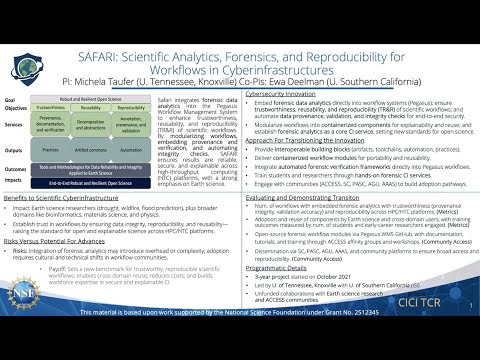
SAFARI
SAFARI
Michela Taufer at CICI Presentation Series
Data
Workflow
PI Michela Taufer discusses the SAFARI project: Scientific Analytics, Forensics, and Reproducibility for Workflows in Cyberinfrastructures. The project aims to integrate forensic data analytics into the Pegasus Workflow Management System to enhance the trustworthiness, reusability, and reproducibility of scientific workflows.
September 25, 2025
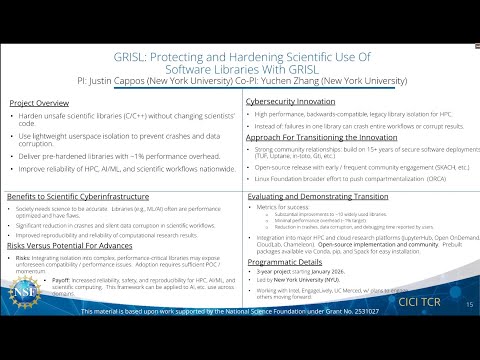
GRISL
GRISL
Justin Cappos at CICI Presentation Series
Cybersecurity
PI Justin Cappos discusses the GRISL project: Protecting and Hardening Scientific Use of Software Libraries with GRISL. The project aims to harden unsafe scientific libraries without changing scientists' code, and to use lightweight userspace isolation to prevent crashes and data corruption, in order to improve the reliability of scientific workflows.
September 25, 2025
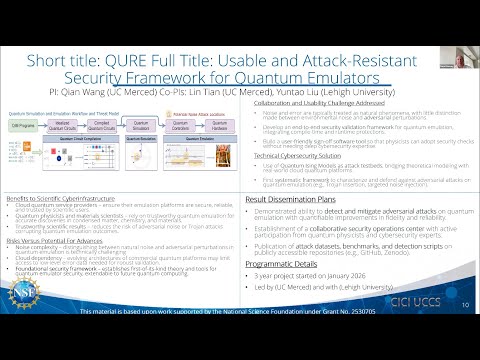
QURE
QURE
Qian Wang at CICI Presentation Series
Data
Cybersecurity
PI Qian Wang discusses the QURE project: Usable and Attack-Resistant Security Framework for Quantum Emulators. The project aims to ensure emulation platforms are trustworthy, reliable, and secure, in order to facilitate scientific research.
September 25, 2025
FoodGuard
FoodGuard
Zhe Zhao at CICI Presentation Series
Data
AI
Cybersecurity
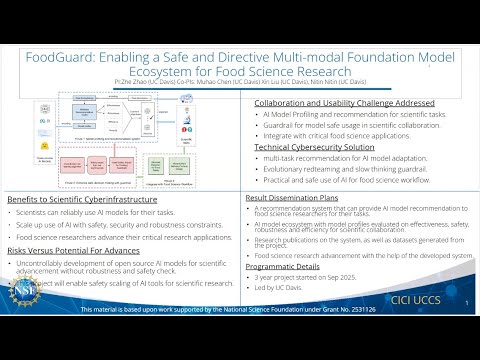
PI Zhe Zhao discusses the project FoodGuard: Enabling a Safe and Directive Multi-modal Foundation Model Ecosystem for Food Science Research. The project aims to provide guardrails for safe usage in scientific collaborations, and to integrate with critical food science applications.
September 25, 2025
MLaaS
MLaaS
Yushun Dong at CICI Presentation Series
Data
AI
Cybersecurity
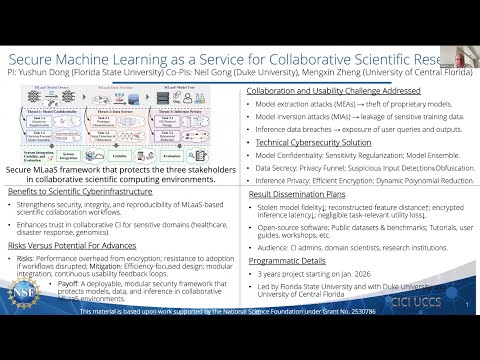
PI Yushun Dong discusses the MLaaS project: Secure Machine Learning as a Service for Collaborative Scientific Research. The project aims to establish a secure framework to protect the three stakeholders in collaborative scientific computing environments: the model owner, the data provider, and the model user.
September 25, 2025
CloudSec
CloudSec
Eunsuk Kang at CICI Presentation Series
Cybersecurity
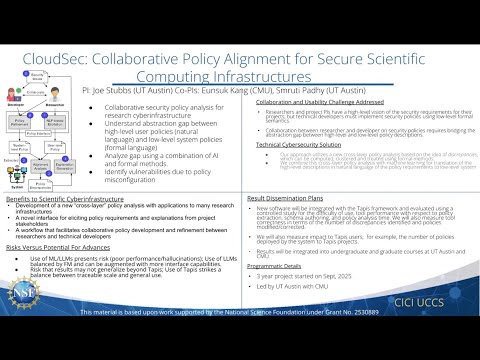
Co-PI Eunsuk Kang discusses the CloudSec project: Collaborative Policy Alignment for Secure Scientific Computing Infrastructures. The project is positioned as a collaborative security policy analysis for research cyberinfrasturcture. It includes a novel interface designed to elicit policy requirements and explanations from project stakeholders.
September 11, 2025
MLDL
MLDL
Wajih Ul Hassan at CICI Presentation Series
Cybersecurity
AI
Data
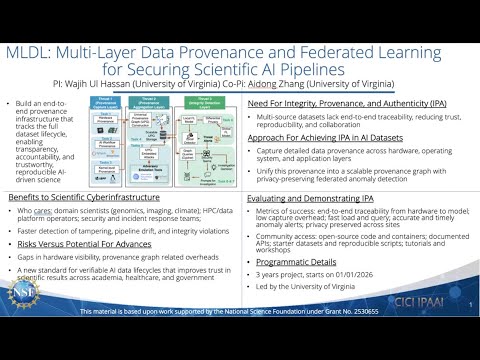
PI Wajih Ul Hassan discusses the MLDL project: Multi-Layer Data Provenance and Federated Learning for Securing Scientific AI Pipelines. The project aims to build an end-to-end provenance infrastructure that tracks the full dataset lifecycle. This would enable transparency and accountability, and allow for trustworthy, reproducible AI-driven science.
September 11, 2025
SafeSCI-TEE
SafeSCI-TEE
Wei Zhang at CICI Presentation Series
Cybersecurity
Data
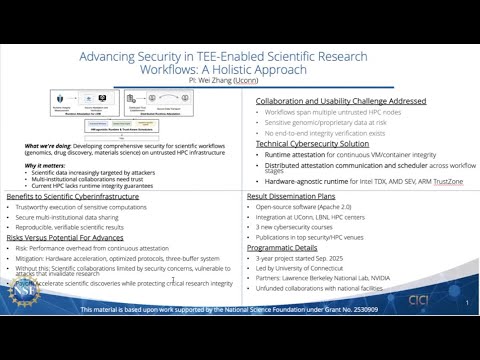
PI Wei Zhang discusses the SafeSci-TEE project: Advancing Security in TEE-Enabled Scientific Research Workflows: A Holistic Approach. Scientific data is increasingly the target of attackers. This project aims to develop comprehensive security for scientific workflows on untrusted HPC infrastructure, with the ultimate goal of safeguarding data, and promoting trust for multi-institutional collaborations.
September 11, 2025
SecGPU4AI
SecGPU4AI
Yanan Guo at CICI Presentation Series
Cybersecurity
AI
PI Yanan Guo discusses the SecGPU4AI project: Securing GPU Computing for AI-Driven Scientific Workflows. The objective of the project is to bolster the security of scientific AI research against GPU memory safety vulnerabilities.
September 11, 2025
HPCSafeChain
HPCSafeChain
Mu Zhang at CICI Presentation Series
Cybersecurity
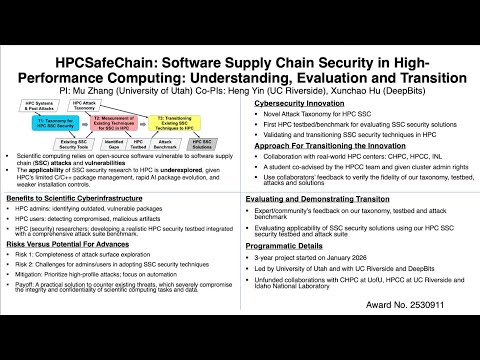
PI Mu Zhang discusses the HPCSafeChain project: Software Supply Chain Security in High-Performance Computing: Understanding, Evaluation and Transition. Scientific computing relies on open-source software vulnerable to software supply chain (SSC) attacks. This project aims to apply SSC security research to high-performance computing, an area that is currently under-explored.
September 11, 2025
WRAP
WRAP
Ying Wang at CICI Presentation Series
Cybersecurity
Networking
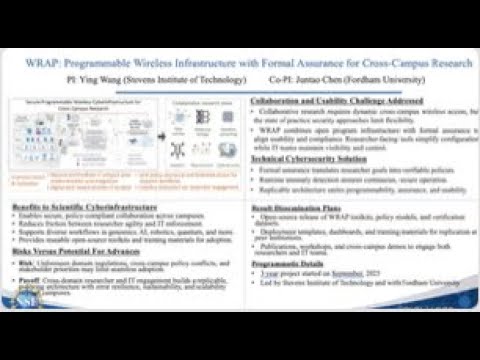
PI Ying Wang discusses the WRAP project: Programmable Wireless Infrastructure with Formal Assurance for Cross-Campus Research. Wang talks about how formal assurance translates researcher goals into verifiable policies and how runtime anomaly detection ensures continuous, secure operation.
September 4, 2025
REPAIRT
REPAIRT
Francesco Restuccia at CICI Presentation Series
Data
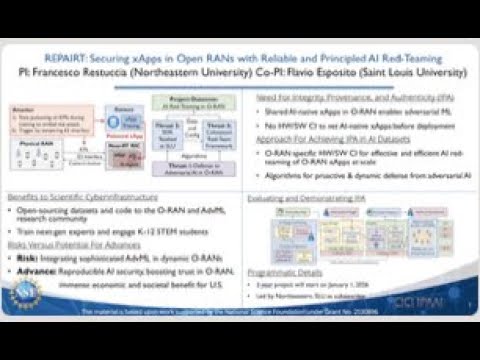
PI Francesco Restuccia discusses the REPAIRT project: Securing XApps in Open RANs with Reliable and Principled AI Red-Teaming. The approach involves algorithms for proactive and dynamic defense from adversarial AI.
September 4, 2025
CANIS
CANIS
Ka Pui (Ricky) Mok at CICI Presentation Series
AI
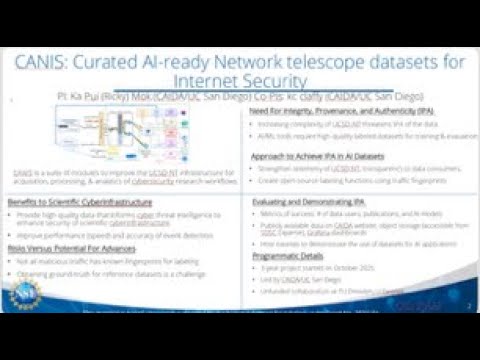
PI Ka Pui (Ricky) Mok discusses the CANIS project: Curated AI-ready Network telescope datasets for Internet Security. Mok shares that CANIS is a suite of modules to improve the USDS-NT infrastructure for acquisition, processing, & analytics of cybersecurity research workflows.
September 4, 2025
SCRYPTS-AI
SCRYPTS-AI
Teodora Baluta at CICI Presentation Series
AI
Data
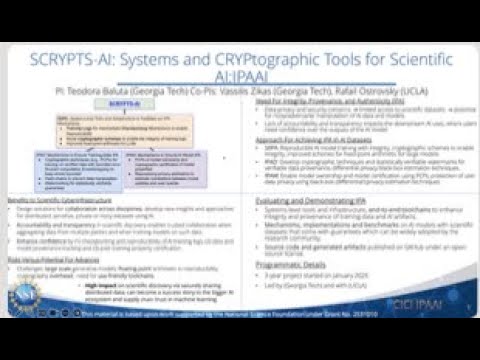
PI Teodora Baluta discusses the SCRYPTS-AI project, whose focus is to design solutions for collaboration across disciplines and develop new insights and approaches for distributed, sensitive and private or noisy data sets using AI.
September 4, 2025
Dprov
Dprov
Yuan Tian at CICI Presentation Series
Data
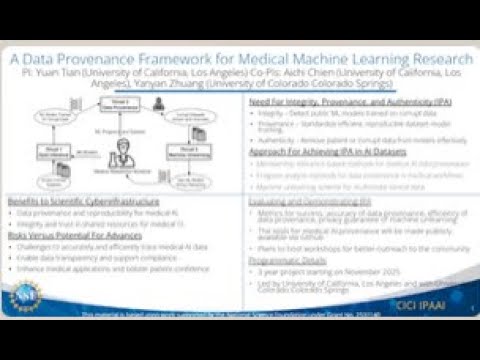
PI Yuan Tian discusses the Dprov project: A Data Provenance Framework for Medical Machine Learning. In this talk Tian reviews the needs for data integrity, provence and authenticity. Integrity involves detecting public ML models trained on corrupt data, Provence involves establishing a Standardize efficient, reproducible dataset-model tracking. Authenticity involves removing patient or corrupt data from models effectively. Tian further discusses data set requirements.
September 4, 2025
ForCORE
ForCORE
Grace Kouadjo at CICI Presentation Series
Networking
August 28, 2025
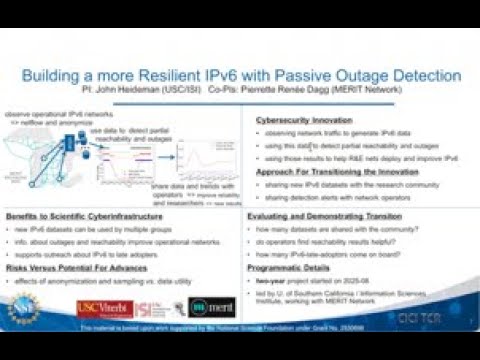
BRIPOD
BRIPOD
John Heideman at CICI Presentation Series
Networking
Data
August 28, 2025
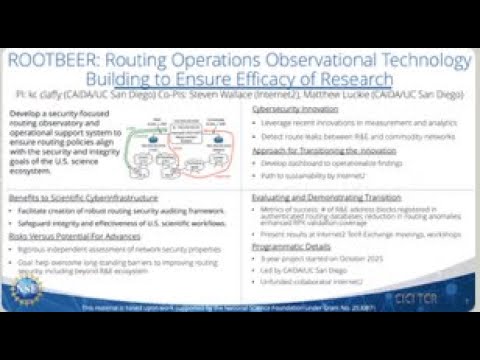
ROOTBEER
ROOTBEER
KC Claffy and Steven Wallace at CICI Presentation Series
Cybersecurity
Networking
August 28, 2025
AICyberLake
AICyberLake
Phuong Cao at CICI Presentation Series
AI
August 28, 2025
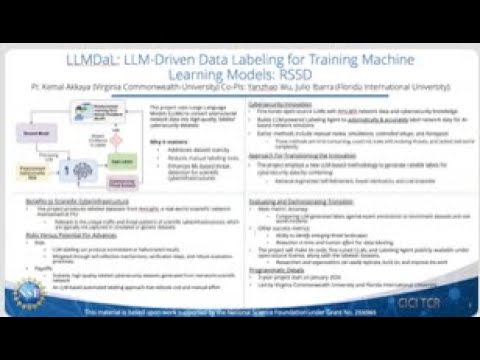
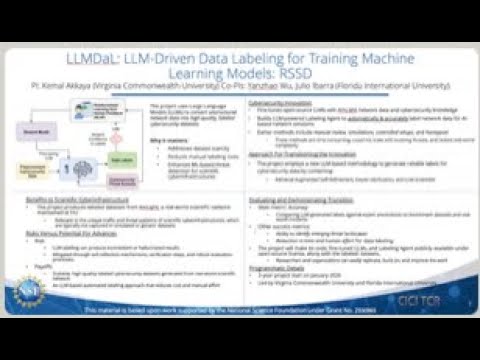
LLMDaL
LLMDaL
Kemal Akkaya at CICI Presentation Series
AI
August 28, 2025
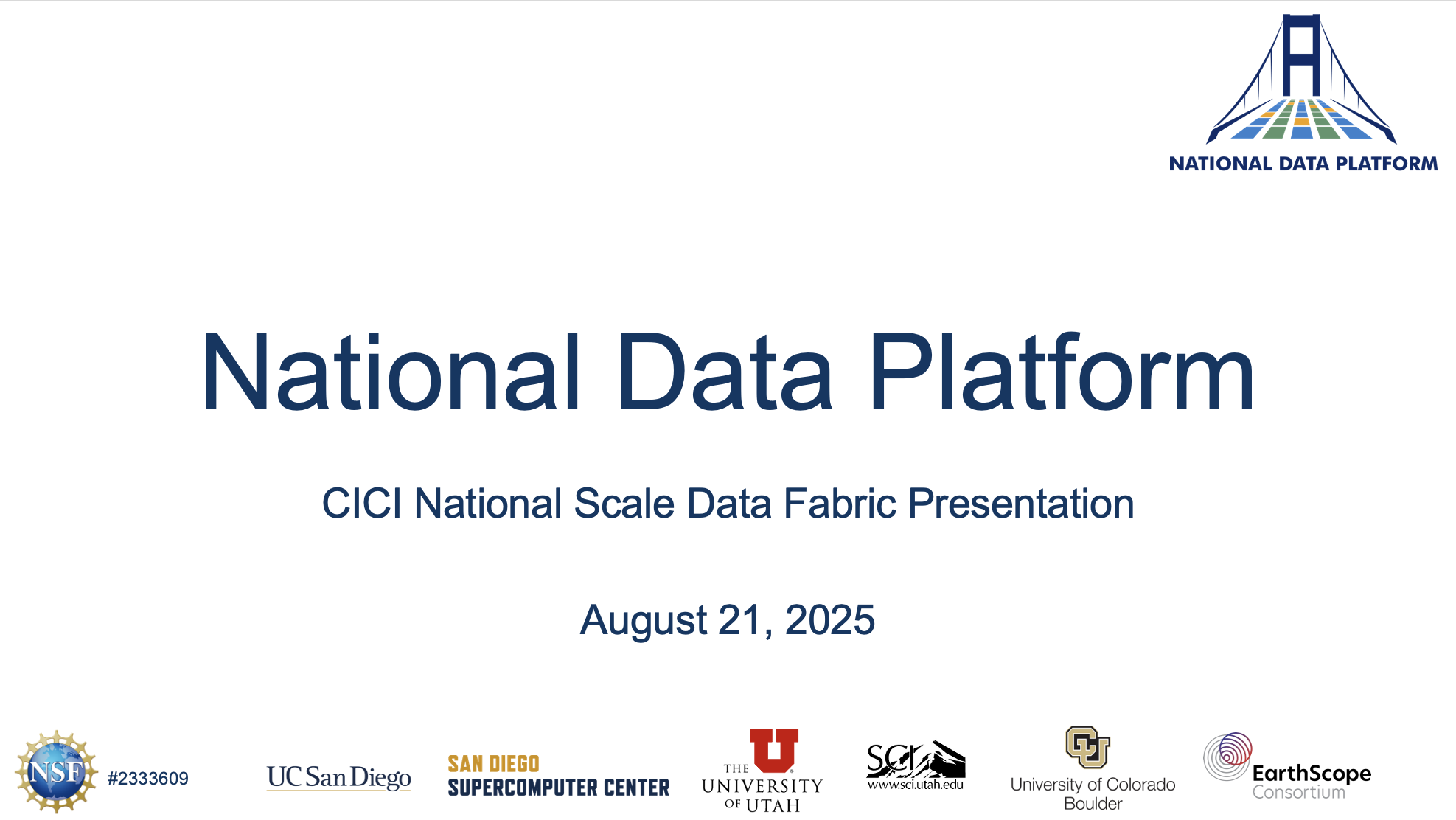
NDP CICI Presentation First Slide
National Data Platform: CICI National Scale Data Fabric Presentation
Ilkay Altintas at CICI Presentation Series
Data
NDP
OSDF
Ilkay Altintas, PI of the National Data Platform, shares how the NDP serves as a central organizing point for different datasets by providing cataloguing and search functionality.
August 21, 2025
OSDF CICI Presentation First Slide
Dear CICI PI: Let's Be Partners
Brian Bockelman at CICI Presentation Series
Pelican
OSDF
Data
Brian Bockelman, PI of the Pelican Platform, describes how the OSDF can partner with CICI PIs (and other producers of research datasets) to share their data and build a community of users, using the OSDF as a platform that can control data access, track data access and distribute data to individuals and computing systems.
August 21, 2025
CICI New Awards First Slide Preview
Cybersecurity Innovation for CyberInfrastructure
Dan Massey at CICI Presentation Series
August 21, 2025
Closing Remarks
Closing Remarks
Miron Livny at HTC25
Mission
Miron Livny provides the closing remarks for HTC25.
June 6, 2025
condor_who (are you)
John (TJ) Knoeller at HTC25
HTCondor
Admin Tools
TJ Knoeller discusses the HTCondor original who use case (who is using the Execution Point (EP), the Execution Point Architecture, Strategy, and the modern who use case. He further discusses condor_who options and the new condor_who strategy.
June 6, 2025
Files Common Across Jobs and How To Transfer Them
Todd Miller at HTC25
HTCondor
Admin Tools
Todd Miller discusses the current tranfer logic, noting that the present mechanism will be released in 24.9, effectively without a UI/UX. The next step, the shiny future plans for 24.10, is to make common file transfer as observable as input file transfer.
June 6, 2025
High-resolution Imaging of the Multi-phase Interstellar Medium with CHTC
Nickolas Pingel at HTC25
Collaborations
Astronomy
Research Computing
Nickolas Pingel science he discusses are the direct result of the “Transformational Survey of Local Group galaxies with the Karl Jansky Very Large Array and HTCondor”, which was funded by the The Office of the Vice Chancellor for Research and Graduate Education’s Research Forward initiative. The success of this project was due to the collaboration between Astronomy and CHTC staff (Bockelman, Livny), who provided direct training and help via dedicated staff members. Pingel talks about the research of radio astronomers which focuses on light emitted in the radio regime. Pingel notes that the early results from these surveys are ushering in a new observational regime for measuring the thermodynamics of the CNM across a diverse range of astrophysical environments.
June 6, 2025
High Throughput Computing for Comparative Genomics on Large Public Datasets
Conor Bendett at HTC25
Biology
Research Computing
OSDF
Conor Bendett shares about his work using HTC for comparative genonimcs for large public datasets. He further discusses CHTC and HTCondor and his experience: noting that there are lots of pipelining small tools; not always the easiest to manage; troubleshooting memory/disk space can be time consuming (unpredictableoutputs) and the great support from CHTC facilitators.
June 6, 2025
Kingfisher -  Toward Explicit Space Management
Kingfisher - Toward Explicit Space Management
Justin Hiemstra at HTC25
Pelican
OSDF
Justin Hiemstra discusses scheduled storage, the core idea we're exploring with Kingfisher. He further discusses Pelican and how it discovers namespaces, how Local or remote policies are joined to populate a Lot DB and how XRootD tracks usage statistics for a Lot DB.
June 6, 2025
Processing Mouse Brain Data on CHTC using Research Drive Integration
Aydan Bailey at HTC25
Biology
Research Computing
OSDF
Aydan Bailey discussed getting started with CHTC for his research, his use of CHTC guides and Offie hours and the challenges setting up Docker image for running custom software. Bailey also dsicussed the advanges of the ResearchDrive integration, that provides a secure, shareable storage and much faster transfers between the storage location and CHTC servers.
June 6, 2025
Using the National Data Platform Endpoint to Improve Access to Science Data
Curt Dodds at HTC25
OSPool
Workflow
HTCondor
Curt Dodds describes the process of deploying the National Data Platform Endpoint (formerly Point of Presence / POP) on local infrastructure to provide a data streaming service for a published science dataset where the data origin is located in Hawaii. From the perspective of a software engineer, he covers the process of deploying the endpoint into a Kubernetes cluster or using Docker Compose. Dodds explains how he integrated access to local data with the endpoint and describe some useful lessons that were learned. Finally, from the perspective of a science user, he demonstrates how to use the deployed endpoint to preprocess data and stream the results to a Jupyter notebook to visualize the data.
June 6, 2025
ARA Distributed Inference Experiments: Flying HTCondor Over a Field of Wireless Dreams
Martin Kandes at HTC25
AI
Workflow
HTCondor
We present the initial design and proposed implementation for a series of long-baseline, distributed inference experiments leveraging ARA --- a platform for advanced wireless research that spans approximately 500 square kilometers near Iowa State University, including campus, the City of Ames, local research and producer farms, and neighboring rural communities in central Iowa. These experiments aim to demonstrate, characterize, and evaluate the use of distributed inference for computer vision tasks in rural and remote regions where high-capacity, low-latency wireless broadband access and backhaul networks enable edge computing devices and sensors in the field to offload compute-intensive workloads to cloud and high-performance computing systems embedded throughout the edge-to-cloud continuum. We highlight the role of HTCondor as the common scheduler and workload manager used to distribute the inference workload across ARA and beyond. We also discuss some of the unique challenges in deploying HTCondor on ARA.
June 5, 2025
Contouring the Audio Fovea with Pinna Cues for Spatial Speech Perception
Bujji Selagamsetty at HTC25
AI
Research Computing
Biology
Bujji Selagamsetty discusses his CHTC GPU workflow. He also noted improvements to CHTC Flow, including HTChirp to poll job ad information and self-scheduling job length and device specific tuning. In his current work he asks what are the regions od 3D audio space where a. speech is more perceptible and b. noise is more distracting. Can we map this space at a fine enough granularity to create more personalized, spatial audio experiences? Selagamsetty summarizes his CHTC experience working on this project.
June 5, 2025
Experiments and expansions: Leveraging PATh tools and NAIRR resources in ML workflows
Ian Ross at HTC25
AI
Workflow
Ian Ross discussed the ML PATh supplement to profile the effects of training on inference on distributed, hetergeneous capacity, Ross talks about the HTCondor's Annex integration with NAIRR sites and use of some new DAG features that could simplify some things.
June 5, 2025
From backend to interactive based on HTCondor
Jingyan Shi at HTC25
Admin Tools
New requirements from HEP data analysis includes limited access to login nodes, resource needed from the experiments program rather than the login nodes and efficient data access for collaborative workflows etc. We have developed an Interactive aNalysis worKbench (INK), a web-based platform leveraging the HTCondor cluster. INK transforms traditional batch-processing resources into a user-friendly, web-accessible interface, enabling researchers to leveage the cluster computing and storage resources directly via their browsers.
June 5, 2025
Functional Throughput Computing
Greg Thain at HTC25
Admin Tools
Research Computing
Greg Thain discusses what is a functional language and the development of a new functional programming language and how thinking in a functional way helps us solve real problems.
June 5, 2025
GPU Access and AI workflows in CHTC and the OSPool
Amber Lim at HTC25
AI
OSPool
Workflow
Amber Lim discusses how to run GPU jobs in CHTC and the OSPool, the researcher-to-AI-workflow-proficiency pipeline, and what you should consider during development.
June 5, 2025
Large Scale Dataset Curation and Model Evaluation
John Peters at HTC25
AI
Research Computing
Biology
John Peters focuses on Feature Extraction in AI workflows and how to leverage CHTC using small zips, Snakemake and caching.
June 5, 2025
Mapping the Zymomonas mobilis Interactome
Sameer DCosta at HTC25
AI
Research Computing
Biology
Sameer D'Costa, a scientist with the Computational Biology Group at the Great Lakes Bioenergy Research Center, is investigating Zymomonas mobilis (bacteria) that is really good at turning sugar into alcohol and could be engineered for industrial use. D'Costa share his deep learning computational plan and workflow to compute complees in Z. Mobilis.
June 5, 2025
Operating a Federated HTCondor Infrastructure: Monitoring and Management for CMS ComputingOperating a Federated HTCondor Infrastructure: Monitoring and Management for CMS Computing
Bruno Coimbra at HTC25
Admin Tools
HTCondor
The Compact Muon Solenoid (CMS) experiment at CERN generates and processes vast volumes of data requiring significant computing capacity. To meet these demands, CMS has adopted a federated throughput computing model distributed across a global infrastructure based on HTCondor, the CMS Submission Infrastructure. Seamless integration of heterogeneous resources from multiple sites allows for operating a unified, virtualized pool. This infrastructure currently provides access to over 500,000 CPU cores, enabling CMS to efficiently execute a wide variety of data processing and simulation workloads.
This federation, however, comes with substantial operational challenges, notably, the need for robust and scalable monitoring. To ensure reliability, performance, and rapid diagnosis of issues, we have developed a comprehensive monitoring ecosystem that spans job execution, resource availability, and system health across the entire pool. This talk will present the architecture of the CMS federated compute infrastructure, detail the role of HTCondor in enabling global workload distribution, and highlight recent developments in monitoring that are critical to operating such a large-scale system effectively.
June 5, 2025
Pegasus WMS Deployments in ACCESS and NAIRR Pilot
Mats Rynge at HTC25
AI
Workflow
HTCondor
Pegasus is a widely used scientific workflow management system built on top of HTCondor DAGMan. This talk will highlight how Pegasus is deployed within the NSF ACCESS ecosystem and the NAIRR Pilot. We will cover access point deployments, including the hosted ACCESS Pegasus platform (Open OnDemand and Jupyter), workflow execution nodes in HPC environments, and a JupyterLab-based access point within the Purdue Anvil Composable Subsystem. On the execution side, we will discuss several provisioning strategies, including HTCondor Annex, custom virtual machines on the Jetstream2 cloud, simple glidein configurations for campus clusters, and a dynamically autoscaled TestPool environment designed for workflow development and testing.
June 5, 2025
Rolling HTCondor Upgrades Without Rolling Over
Tim Theisen at HTC25
Admin Tools
HTCondor
Tim Theisen discusses how to upgrade your HTCondor Pool without users noticing.
June 5, 2025
Tighter HTCondor and Kubernetes interplay for better glideins
Igor Sfiligoi and Jamie Frey at HTC25
Admin Tools
HTCondor
HTCondor is the leading system for building a dynamic overlay batch scheduling system on resources managed by any scheduling system, by means of glideins. One fundamental property of these setups is the use of late binding of containerized user workloads. From a resource provider point of view, a compute resource is thus claimed before the user container image is selected. Kubernetes allows for both multi-container requests and dynamic updates to the container image being used. In this talk we show how HTCondor can exploit these features to both increase the effectiveness and the security of gildeins running on top of Kubernetes-managed resources.
June 5, 2025
Tracking HTCondor Uptime
Michael Pelletier at HTC25
Admin Tools
HTCondor
Michael Pelletier discusses the usefulness of uptime metrics, how built-in daemon attributes are linked to service uptime, how to create custom attribute such as an UptimeExecMonthly attribute. While the DaemonStartTime and MonitorSelfAge attributes of HTCondor daemons provide a slice of insight as to the uptime and availability of the service, they're not well-suited for tracking longer-term up/down-time stats over the course of days, weeks, or months. Longer-time-period uptime statistics are essential for contractual Service Level Agreement (SLA) management, and are an important aspect of monitoring the overall health of large HTCondor pools.
June 5, 2025
Utilizing HTCondor, Pelican, and DAGman workflows for high-throughput phenotyping in dairy cattle
Ariana Negreiro at HTC25
AI
Research Computing
Biology
Ariana Negreiro disusses the Digital Livestock Lab at the UW-Madison Dept of Animal and Dairy Sciences which focuses on research applications of ML and computer vision for farm management and genetic selection. Negreiro disucssed the data processing pipeline and the CHTC Resources (HTCondor, Pelican and DAGMAN) that they rely upon for their work.
June 5, 2025
What's New, What's Upcoming
Todd Tannenbaum at HTC25
Admin Tools
Research Computing
HTCondor
Todd Tannenbaum discusses what's new in the HTCondor Software Suites (HTCSSS) and what's coming up. Topics include Release numbering Scheme, using container images, new authenticated docker support, Pelican local cache on the EP, sharing input common files, and more.
June 5, 2025
A Tape Robot for the MIT Tier-2 Center
Maxim Goncharov at HTC25
Collaborations
Admin Tools
Since its establishment in 2006, the MIT Tier-2 computing center has been a long-standing contributor to CMS computing efforts. Recently, an opportunity arose to take part in the usage of a shared tape storage system operated by Harvard University. In the context of a pilot project to explore this system we acquired tape cartridges with a total capacity of 15 PB and successfully integrated them for use by CMS. A key challenge was the lack of direct access to the tape libraries. To address this, we developed a novel setup that is currently unique within the CMS infrastructure. In this talk, we present our technical approach and share insights that may benefit other sites considering participation in shared tape storage systems.
June 4, 2025
Building Communities Around OSDF and OSPool Contributors
Christina Koch, Tim Cartwright at HTC25
Campuses
Facilitation
OSDF
OSPool
Mission
Christina Koch, OSG Rsearcher Facilitation Lead, and Tim Cartwright, OSG Campus Coordinator, discuss how buildling the community of contributors is an inseparable aspect of providing the OSDF, OSPool and OSStore.
June 4, 2025
Collaboration Services & Usage
Pascal Paschos at HTC25
Collaborations
Mission
Pascal Paschos discusses PATh Collaboration Services that coordinates effort at the intersction of multple services for collaborations at global scale of intrastructure and communities, nothing the 20 - 25% grown in cpu hours and 70% growth in gpu hours over the past year.
June 4, 2025
Computing Requirements and Challenges for Muon Collider Full Simulation
Mark Larson at HTC25
Collaborations
Admin Tools
Mark Larson discusses the computing requirements and resouces needed for the Muon Collider and the solutions to these computing challenges. Larson also discusses the experience running HTCondor jobs and how the OSG/PATh provided resources have proven exremely useful.
June 4, 2025
Data Everywhere: Using and Sharing Scientific Data with Pelican
Andrew Owen at HTC25
Research Computing
Admin Tools
Pelican
OSDF
While there are perhaps hundreds of petabytes of datasets available to researchers, instead of swimming in seas of data there is often a feel of sitting in a data desert: there’s a mismatch between what sits in carefully curated repositories around the world versus what’s accessible at the computational resources locally available. The Pelican Project (https://pelicanplatform.org/) aims to bridge the gap between repositories and compute by providing a software platform to connect the two sides. Pelican’s flagship instance, the Open Science Data Federation (OSDF), serves billions of objects and more than a hundred petabytes a year to national-scale resources. This tutorial, targeted at end-user data consumers and data providers, will cover the data access model of Pelican, guide participants to access and share data through an existing data federation, and consider how data movement via Pelican and the OSDF can enable their research computing.
June 4, 2025
Data processing in XENONnT dark matter project
Dacheng Xu at HTC25
Collaborations
Workflow
Dacheng Xu discussed the SENON Collaboration, the goals of data reprocessing, the data flow, their use of the Pegasus workflow management software, and use of HTCondor
June 4, 2025
Duct Tape, DAGs, and Determination: Snakemake at the Edge of HTCondor
Justin Hiemstra at HTC25
Research Computing
Workflow
HTCondor
Justin Hiemstra presents about Snakemake and research computing workflows
June 4, 2025
EWMS in Action: A User’s Guide to Adaptive, Extreme-Scale Workflows
Ric Evans at HTC25
Research Computing
Collaborations
Workflow
The Event Workflow Management System (EWMS) enables previously impractical scientific workflows by transforming how HTCondor is used for massively parallel, short-runtime tasks. This talk explores what’s now possible from a user’s perspective. Integrated into IceCube’s Realtime Alert pipeline and powered by OSG’s national-scale compute resources, EWMS’s debut application delivers directional reconstructions of high-energy neutrinos within minutes. This talk will showcase how EWMS is accelerating discovery today and explore how its capabilities could unlock new research across domains—from astrophysics to protein modeling, large-scale text mining, and beyond.
June 4, 2025
Hollistic cost analysis of running a computing center
Zhangqier Wang at HTC25
Admin Tools
The MIT Tier-2 computing center, established in 2006, has been a long-standing contributor to CMS computing. As hardware ages and computing demands evolve, we are undertaking a major redesign of the center’s infrastructure. In this talk, we present a holistic cost analysis that includes not only hardware purchases but also power consumption, cooling, and rack space—factors often excluded from conventional cost models. We evaluate the cost-effectiveness of maintaining aging hardware versus timely replacement, and propose optimal hardware retirement and procurement policies.
June 4, 2025
IceCube and PATh Services
Benedikt Riedel at HTC25
Collaborations
Admin Tools
OSDF
Pelican
Workflow
Benedikt Riedel discusses IceCube Computing, an global heterogeneous resources pool - powered by PATh services and products using mostly shared and opportunistic resources. Riedel also discussed the Event Workflow Management Serivce and current and future integrations.
June 4, 2025
Integration of MINCER with Open Science Grid
Irvin Lopez-Audetat at HTC25
OSPool
Admin Tools
Irvin Lopez-Audetat discusses the Monitoring Infrastructure for Network and Computing Environment Research (MINCER) project that aims to provide a foundation for in-depth insight and analysis of distributed heterogeneous computing environments, supporting and enhancing research and education in computer and network systems. Our approach is to work in conjunction with the Open Science Grid (OSG).
June 4, 2025
Managing, Maintaining, and Monitoring a large HTC system
Tom Smith at HTC25
Collaborations
Admin Tools
HTCondor
Tom Smith from the BNL Scientific Computing and Data Facility (SCDF) discusses its integration with HTCondor, upgrade strategies, monitoring, and wish list.
June 4, 2025
Monitoring and diagnostics to support scaling up radio astronomy imaging workflows
Felipe Madsen at HTC25
Collaborations
Admin Tools
Workflow
Astronomy
The Algorithms Research and Development Group (ARDG) at the National Radio Astronomy Observatory (NRAO) has been using HTCondor and compute resources at the Open Science Grid (OSG) to significantly improve throughput in radio astronomy imaging by up to 2 orders of magnitude in single imaging workflows, and we are currently putting efforts towards extending these imaging capabilities to multiple imaging workflows. Besides developing and maintaining software to efficiently process data and manage the imaging workflows, we found that monitoring and diagnosing workflow executions is critical to achieve and maintain high throughput. We will present and discuss some of the tools and methodology that we use to assess workflow health and efficiency, which enable us to visualize and solve problems, eventually also contributing to optimizing and advancing capabilities of HTCondor and the OSG.
June 4, 2025
Status of REDTOP and preliminary results from the 2025 Montecarlo campaign
Corrado Gatto at HTC25
Collaborations
Corrado Gatto discussed REDTOP's main physics goals, cost estimates for its work, the Collaboration, the storage & CPU expected data rates, the Montecarlo Campaign 2025 and the OSG Usage Statistics from that work.
June 4, 2025
The EP’s Disk-iplinary Resource Management: Managing Storage at the Execution Point
Cole Bollig at HTC25
Admin Tools
HTCondor
Cole Bollig discusses how the EP enforces disk usage, how to enable disk enforcement and the benefits gained.
June 4, 2025
Unbreaking the bird: Debugging Pelican client failures
Brian Bockelman at HTC25
Admin Tools
Pelican
OSDF
Brian Bockelman presents on the Pelican work debugging Pelican client failures and approaches to learn what happened.
June 4, 2025
Wrangling Complex Notebook Workflows with Floability
Douglas Thain at HTC25
Research Computing
Workflow
Computational notebooks have become a critical tool of scientific discovery, by wrapping together code, results, and visualization into a common package. However, moving complex notebooks between different facilities is not so easy: complex workflows require precise software stacks, access to large data, and large backend computational resources. The Floability project aims to connect these two worlds, making it possible to specify, share, and execute computational workflows through the familiar notebook interface. This talk will introduce the Floability concept of a workflow "backpack" and demonstrate applications in high energy physics, machine learning, and geosciences.
June 4, 2025
Experiences of a Small, Primarily Undergraduate Institution in Servicing OSPool Compute Jobs
Stephen Wheat at HTC25
Campuses
Facilitation
Wheat, Senior Professor of Computer Science at Oral Roberts University, discusses the campus CC* awards, contributing to the OSPool and its impact on the ORU faculty and students.
June 3, 2025
Integrating NSF NCAR’s data infrastructure with OSDF
Harsha Hampapura at HTC25
Pelican
OSDF
NSF NCAR’s labs and programs collectively cover a breadth of research topics in Earth system science, from the effects of the Sun on Earth's atmosphere to the role of the ocean in weather and climate prediction, as well as supporting and training the next-generation of Earth system scientists. However, with the current legacy `download and analyze’ model followed by most of our remote users, we are not realizing the full research potential of NCAR’s wealth of datasets. Our goal is to integrate NCAR’s curated data collections with the OSDF data and compute fabric to broaden access capabilities. In this talk, we present progress on this collaboration and demonstrate geoscience workflows which ingest data from NCAR’s Research Data Archive using pelicanFS via OSDF caches.
June 3, 2025
National Science Foundation Campus Cyberinfrastructure (CC*)
Kevin Thompson at HTC25
Campuses
Facilitation
OSDF
Kevin Thompson from the Office of Advanced Cyberinfrastructure of the National Science Foundation discussed the Camus Cyberinfrastructure (CC*) vision. Thompson discusses the CC* Program that is Coordinated in networking, compute and storage. Thompson also discusses the contributors to the OSPool and the services of the OSDF.
June 3, 2025
Scaling Up Research: Integrating CENVAL-ARC resources with OSG and Expanding User Access
Sarvani Chadalapaka at HTC25
Campuses
Facilitation
Sarvani Chadalapaka discusses UC Merced's Cyberinfrastructre and Research Technologies Mission and both its contribution and use of OSG resources, noting that they chose OSG because of its alignment with CC* requirements, pre-proposal and deployment support and training and onboarding support.
June 3, 2025
Supporting MicrobiologyResearch at Scale: Experiences and Perspectives
Patricia Tran at HTC25
Facilitation
Biology
Research Computing
Biology
Patricia Tran, bioinformatics and computational pipeline scientist, bioinformatics research support service, discusses working with big data in biology and the requirements to be scalable, flexible and use high throughput computing.
June 3, 2025
Supporting Research Computing @ Syracuse University
Peter Pizzimenti at HTC25
Campuses
Facilitation
Peter Pizzimenti, Associate Director of Research Computing at Syracuse University, discusses why Syracuse invests in research computing, What it takes to support research computing and where they are going.
June 3, 2025
Translational Computer Science Panel Discussion
Panel Discussion at HTC25
Mission
Join Brian Bockelman, Douglas Thain, Ewa Deelman, Manish Parashar, Miron Livny, and Peter Couvares for a panel discussion on translational computer science.
June 3, 2025
University of Montana and Contributing to the OSPool
Michael Couso at HTC25
OSPool
Campuses
Facilitation
Michael Couso, a research computing support supervisor, discussed how the University of Montana became a contributor to the OSPool. Couso discussed connecting to the OSPool and opening the door to a broad community and the process of scaling up and growing outward.
June 3, 2025
Can I have my data... please? Authorization in Pelican
Justin Hiemstra at HTC25
Pelican
Justin Hiemstra discusses access to data via tokens that you bring to the Origin to get your data. Hiemstra's talk explores the problems this complex system is trying to solve, why we don't use something simple like passwords and what Pelican is going to make it easier for users.
June 2, 2025
CHTC Fellow Lightning Talks
Sandy Nayar, William Jiang, and Kashika Mahajan at HTC25
Fellows
Pelican
CHTC Fellows discuss the work and goals of their Fellows Projects - for CHTC and Pelican
June 2, 2025
Computational challenges in metagenomics and small molecule biosynthesis
Jason Kwan at HTC25
Research Computing
Biology
Jason Kwan presents on the use of high-throughput computing in metagenomics research, discussing how CHTC allows for large-scale searches and metagenomic assemblies that require a lot of RAM.
June 2, 2025
David Swanson Awardee Presentation: Reconstructing Spider Webs from Behavioral Tracking
Brandi Pessman at HTC25
Research Computing
Biology
The OSG David Swanson award is awarded each year in memory of David Swanson to an attendee of the OSG School who has gone on to do interesting things. This year's recipient, Brandi Pessman, presents on how spiders respond to rising noise levels in cities. Using high-throughput computing, Brandi digitally reconstructed spider webs to track spider movements during web construction.
June 2, 2025
Erik Wright's Keynote Presentation: Biological Discovery at an Unfathomable Scale
Erik Wright at HTC25
Research Computing
Biology
Recent technological advances have revealed an enormous diversity of lifeforms by sequencing their genomes. There are now millions of available genomes, each comprised of thousands of genes. The universe of newly discovered genes is expanding far faster than our ability to study them in the laboratory. Here, Erik Wright presents how high-throughput computing is unlocking the function of novel genes at an unfathomable scale.
June 2, 2025
Expanding Facilitation Impacts
Christina Koch at HTC25
Facilitation
Mission
Christina Koch presents on facilitation impacts at HTC25. Lead Research Computing Facilitator Christine Koch describes the facilitation services provided to researchers and ways to connect. In addition, Koch discusses PATh's role as a resource provider for NAIRR and building a data community.
June 2, 2025
Fermilab’s Transition to Token Authentication
Dave Dykstra at HTC25
Admin Tools
Collaborations
Fermilab is the first High Energy Physics institution to transition from X.509 user certificates to authentication tokens in production systems. All the experiments that Fermilab hosts are now using JSON Web Token (JWT) access tokens in their grid jobs. The tokens are defined using the WLCG Common JWT Profile. Many software components have been either created or updated for this transition, and the changes to those components are described. Most of the software is available to others as open source. There have been some glitches and learning curve issues but in general the system has been performing well and is being improved as operational problems are addressed.
June 2, 2025
Navigating the PATh Forward
Miron Livny at HTC25
Mission
Miron Livny provides the opening remarks for HTC25. Livny discusses the Center for High Throughput Computing (CHTC) vision: Distributed high throughput computing and research computing facilitation are powerful enables or scientific discovery; The value proposition of throughput computing for researchers with AI workloads, and translational (computer) science. He also discusses that building a lasting relationship with a community requires an evolving value proposition and mutual trust.
June 2, 2025
Our Current Vision for Trustworthy Long-Term CILogon Operations
Jim Basney at HTC25
Admin Tools
Jim Basney presents on CILogon, a 15+ year effort to enable secure longon to scientific cyberinfrastructure (CI) for seamless identity and access management using federated identities (SAML, OIDC, OAuth, JWT) so researchers log on with their existing credentials.
June 2, 2025
Placement Tokens: Capability-Based Authorization for Job Placement
Mátyás Selmeci at HTC25
Admin Tools
HTCondor
Mátyás Selmeci discusses placement tokens, experimental work in the area of authorization to make it easier to grant, audit, and revoke access to the job placement services that an Access Point provides.
June 2, 2025
State of OSG
State of OSG
Frank Wuerthwein at HTC25
Facilitation
Mission
Frank Wuerthwein, OSG Executive Director, discusses the current state of OSG, the compute and data services provided by OSG, fun facts on usage, and goals for the future.
June 2, 2025
The Pelican in Flight: Delivering Data Services
Brian Bockelman at HTC25
Pelican
OSDF
Brian Bockelman, the Pelican Platform PI, discussed what Pelican does, and how it can be used. Bockelman discusses the Pelican Project that builds a software platform that delivers data to throughput computing and the Open Science Data Federation (OSDF), a global deployment of the platform.
June 2, 2025
Understanding Gene Regulatory Networks
Prakriti Garg at HTC25
Research Computing
Biology
Prakriti Garg presents on using throughput computing to study the gene regulatory network using network inference and unsupervised learning
June 2, 2025
Using OSG to learn the rules of biological evolution
Oana Carja at HTC25
Research Computing
Biology
Oana Carja discusses using the OSPool and high throughput computing in the field of biological evolution, with the aim of understanding the rules that govern evolutionary processes.
June 2, 2025