



Ecologists utilizing HTC to examine the effects of megafires on wildlife
Bryna Goeking
February 26, 2024
Studying the impact of two high-fire years in California on over 600 species, ecologists enlist help from CHTC.
The western United States is seeing an unprecedented increase in wildfires. Researcher
Jessalyn Ayars and her
team examined how severe wildfires impact the habitats of over 600 species across two megafire
years in California. Ayars, a former Post-Baccalaureate Research Fellow at the Rocky Mountain
Research Station located in Colorado, investigated this impact on wildlife with Dr. Gavin Jones
and Dr. Anu Kramer of the University of Wisconsin—Madison.
Their research was enabled by capacity provided by the Center for High Throughput Computing (CHTC)
and published in the Proceedings of the National Academy of Sciences.
“Megafires are extremely large, high-severity fires. They are increasing worldwide, especially in the western U.S.”
Ayars explained. “In 2020 and 2021 California experienced a severe fire season.” California was also favorable for
the team to study due to its extensive maps showing the habitat suitability for all vertebrate species. Typically,
ecologists will study the effects of one species or a small number of species after wildfire — Ayars’ research is
novel in that it surveys a wide range of species.
Surveying a wide range of species across a state led to a bottleneck of data to analyze: “Each species was a gigantic
math problem across the state of California. We were dealing with 608 vertebrae species, each with a suitability map
the size of California at a 30-meter resolution. To get our results we needed to overlay the fire maps [with] the
habitat suitability maps to see how much area burned, and in what severity.”
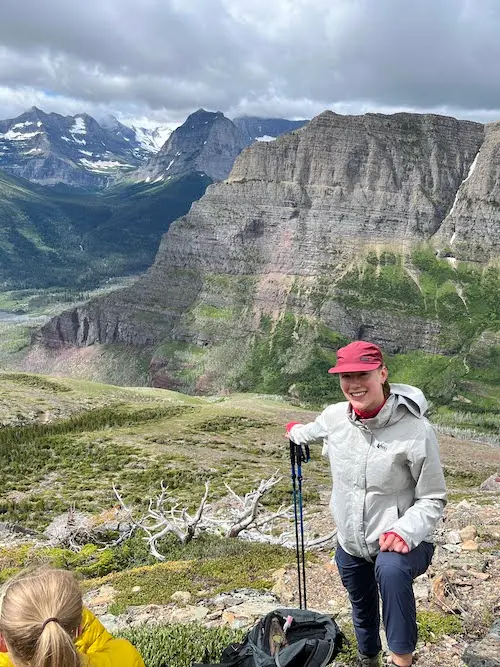
Very quickly, Ayars knew that doing this hundreds of times by hand was impractical. “That’s just so much data —
it wasn’t possible to do it all on a desktop computer,” she said. Ayars learned about the CHTC from her advisor
at the Rocky Mountain Research Station, Dr. Gavin Jones, who received his Ph.D. from UW-Madison and had connections
with CHTC from earlier research.
The CHTC Research Computing Facilitators (RCF) helped Ayars and her team break down large chunks of data into smaller
jobs that could scale-out to run simultaneously using capacity provided by the NSF funded OSPool.
“The folks at CHTC were super helpful in setting me up for all the processing, breaking down that giant problem
into one species and one fire severity at a time so they could run in parallel" across the more than 50 sites that
contribute capacity to the OSPool, she said.
“I would recommend anyone interested in using HTC [high throughput computing] or just curious about whether or
not it would be helpful for their work to reach out to CHTC,” she said. “It’s a great resource and they’re great
at teaching you.” Ayars gave a special shout-out to Rachel Lombardi and Christina Koch, two RCFs at CHTC. Research computing facilitators
help new or potential users of CHTC services understand what computing resources are available on and off the UW-Madison
campus and provide support for adapting workloads to harness HTC.
Ayars hopes that her team’s work will be a “call to action” for other wildlife ecologists studying the impact of wildfires
on species. “These conditions are so different from what wildlife evolved in, and from what researchers have studied wildfire
in. It’s hard to say how wildlife will respond to these wildfires going forward.”