


OSG User School 2017
November 29, 2017
The OSG User School 2017 was held at the University of Wisconsin–Madison on July 17–21.
There were 56 participants, including mostly graduate students, post-doctoral researchers,
a few advanced undergraduates, several faculty, and some research staff from research
institutions in the United States (and one each from England and Spain). The range of
scholarly domains was one of the most diverse yet, including physics, biology, chemistry,
medicine, engineering, statistics, earth sciences, plant sciences, and economics. Participants
were selected by demonstrating need for large-scale computing and by being in a position
to transform their scholarly work through computation. The instructors this year were Bala
Desinghu, Brian Lin, and Derek Weitzel from the OSG, plus Christina Koch and Lauren Michael
from the UW–Madison’s Center for High Throughput Computing.
This year’s curriculum retained its focus on hands-on practice with a wide variety of user
tools, providing a solid grounding for advanced and theoretical topics later in the School,
as well as further learning afterward. Much of the curriculum was carried over from 2016,
with minor updates to stay current. However, some sections of the curriculum were updated
more significantly, including the first-day materials on running jobs locally with HTCondor
and the last-day capstone exercise and its end-to-end workflow example. The larger changes
reflected both changes in the technologies involved plus improved pedagogical approaches
based on experiences with past OSG User Schools and other science end-user engagements.
All of the training materials from
the School remain available online indefinitely, in case they are helpful as reference material.
Also, participants received several clear options for getting ongoing help with their large-scale
computing needs. Plus, every participant left the School with at least two ways to run jobs —
an account on a UW–Madison HTCondor submit node and an OSG Connect account — so that there
are as few barriers to computing and storage resources as possible.
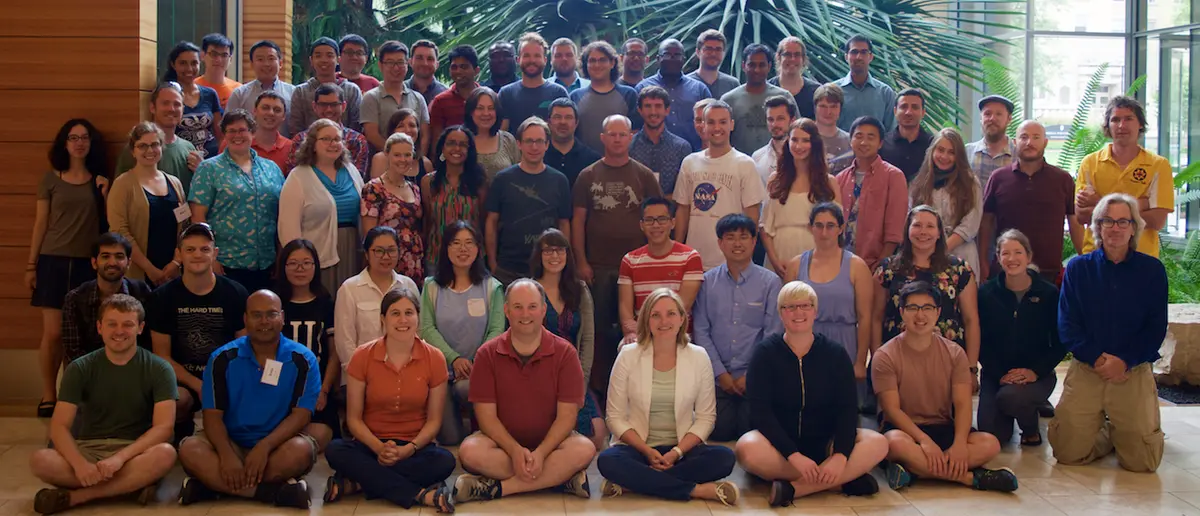
The attendees of the OSG User School in 2017.
From formal training evaluations to informal comments and emails, the School was clearly a
success. Participants were happy with the program, with how much they learned, and with the
new paths that are now open to them. Further, many participants completed a final written
assignment after the event, describing a research computing challenge and their plans for
applying material from the School to handle the challenge using distributed high throughput
computing. From these assignments, it is clear that most participants have concrete, realistic
plans to advance their research through computing, and many have already begun doing so.
-- Tim Cartwright